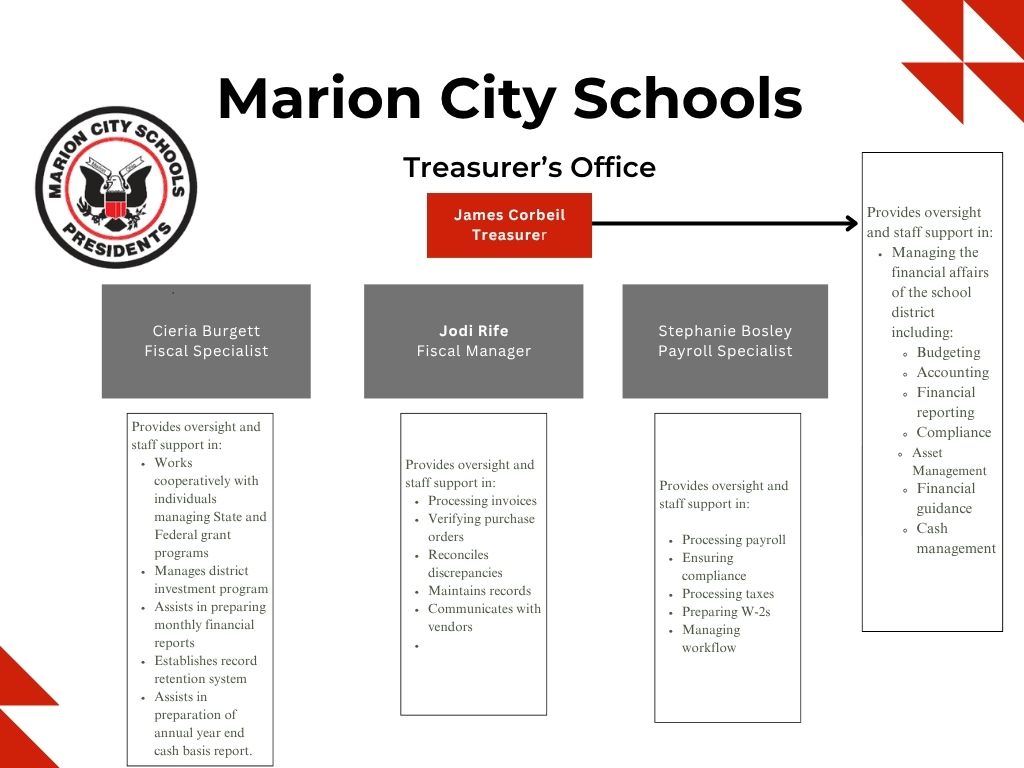
Dear Marion City Community,As Treasurer, I serve as the district’s Chief Financial Officer, responsible for safeguarding all public funds, managing our budget, overseeing payroll, and ensuring every dollar is spent wisely and transparently. I also serve as Secretary to the Board of Education, helping maintain clear records and supporting informed decision-making. My role is to provide strong financial stewardship, ensure full compliance with state requirements, and communicate openly with our community so that taxpayers can trust how their investment supports our students.
We believe strongly in fiscal transparency and prudent stewardship. Our community asks us to be thoughtful and efficient, and we take that responsibility seriously. We work to ensure that tax dollars go further, supporting classrooms, staff, materials, and student services, not being diverted by inefficiency or unchecked costs. We want our community to trust that we spend for students first and do so in a way that maximizes impact.
At the same time, we feel a growing urgency to inform you about a state-level trend that shifts more of the burden to local taxpayers and could affect our ability to maintain the quality of education you expect.
What’s happening at the state level
Ohio has enacted major changes to property tax law intended to provide homeowners with tax relief. A package of bills passed the General Assembly in November 2025, and Governor DeWine signed it in December 2025, with provisions taking effect in early 2026.
Simply: state leaders changed how certain parts of the property tax system work. Two changes in particular could impact Marion City Schools:
A long-standing “growth limiter” is changing. Ohio adjusted how a school district’s guaranteed minimum property tax rate is calculated—one mechanism that can affect how much local revenue grows over time, even when property values rise.
Counties now have new authority to reduce certain levies. The new law allows county budget commissions to reduce property-tax millage in some situations. That may lower taxes for homeowners, but it can also reduce school funding.
These changes aim to provide tax relief for families. The trade-off is that school districts may not see the same growth in local revenue, which could mean fewer resources unless the state increases support or the community helps fill the gap.
What this means for Marion City Schools
We will need to:
Stay transparent and careful with every dollar.
Plan for slower local revenue growth and adjust forecasts as the new rules take effect.
Keep our community informed about how these changes impact our schools.
Advocate for state decisions that don’t shift too much of the cost to local taxpayers.
Stay focused on using every dollar to benefit students.
We are committed to being open, responsible, and proactive. Thank you for your trust and support as we navigate these statewide discussions together.
With gratitude and respect,
James Corbeil